
HOW TO CHOOSE
YOUR SKI BOOTS
Choosing the right ski boot is essential. It is, in fact, what makes the link between your foot and your ski. The shoe must give you strength and comfort. It will transmit information to the ski, energy, but also insulate your foot, protect it from the cold.
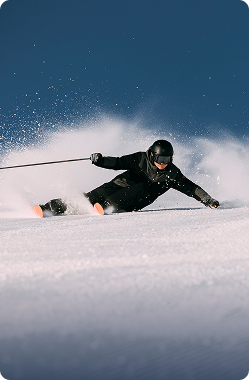
Your skill level
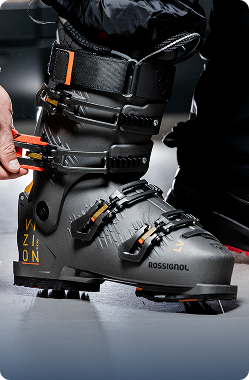
Your discipline
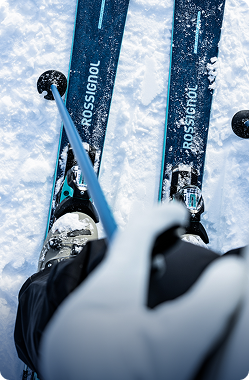
The flex

The width
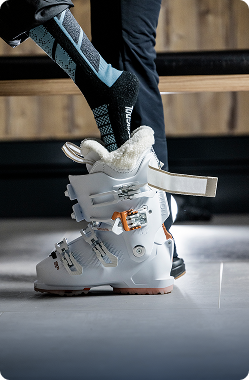
The size
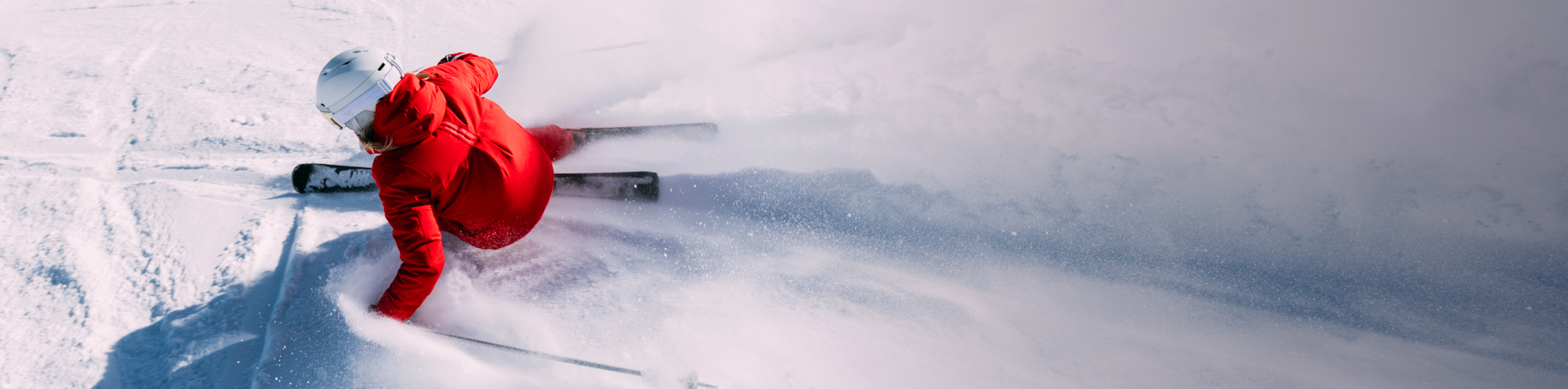
1. HOW TO CHOOSE SKI BOOTS BASED ON YOUR SKILL LEVEL
When choosing the right ski boots, it’s important to consider your skill level, as the fit and flex of the boot directly impact comfort, control, and performance on the slopes. Ski boots come in different stiffness and features depending on whether you're a beginner, intermediate, or expert skier, and selecting the appropriate pair based on your ability will make a big difference in your overall skiing experience.
BEGINNER SKI BOOTS :
For beginners, comfort and ease of use are essential. Choose softer flex boots, as they are generally more forgiving and easier to control. Softer boots allow for more natural movement and flexibility, helping you learn the basics of skiing without feeling too restricted.
That said, boot flex should also be matched to your anatomy. A skier’s weight and strength play a big role: lighter skiers often need softer flex to bend the boot effectively, while heavier or stronger skiers may require a slightly stiffer flex—even at the beginner level—for proper support and stability.
Beginner boots should still offer a snug, comfortable fit to prevent pressure points and blisters, while allowing smoother turns and greater stability at slower speeds.
INTERMEDIATE SKI BOOTS :
As you progress to an intermediate skier, you’ll want ski boots that provide a balance between comfort and performance. Medium-flex boots offer more support and control while still being flexible enough to maneuver through different types of terrain. They allow for better precision in turns and provide more stability at higher speeds compared to softer boots. Look for boots with a snug fit that offer adequate control but also allow for some movement, providing a good blend of comfort and performance.
EXPERT SKI BOOTS :
For expert skiers, stiff flex boots are essential. These boots provide the highest level of control, responsiveness, and power transmission, especially at high speeds and on challenging terrain. Stiff boots are ideal for those who ski aggressively, require quick edge-to-edge transitions with snap, and demand maximum precision for carving and technical maneuvers.
An expert boot should fit snugly and provide excellent support without any discomfort. Engineered for immediate energy transfer, these boots convert subtle skier inputs into powerful turns with minimal lag, ensuring stability and accuracy on steep slopes, deep powder, and variable snow conditions.

Chaussures de ski de piste homme VIZION 4B PRO 100 MV GW
337.50 EUR

Chaussures de ski de piste femme VIZION 4B ELITE 90 GW
412.50 EUR

Chaussures de ski de Piste homme HI-Speed Pro 130 CA MV GW
354.00 EUR

Chaussures de ski FREE RANDONNÉE homme Alltrack Pro 130 LT MV GW
455.00 EUR

Chaussures de ski de piste homme VIZION 4B PRO 120 MV GW
412.50 EUR

Chaussures de ski All Mountain Femme Alltrack Pro 100 LT GW
350.00 EUR

Chaussures de ski Racing unisexe Hero World Cup Za
498.00 EUR

Chaussures de ski de Piste femme Pure 70
210.00 EUR

Chaussures de ski All Mountain homme Alltrack 130 HV GW
322.00 EUR

Chaussures de ski de piste homme HI-Speed Elite 130 CAR LV GW
354.00 EUR

Chaussures de ski All Mountain Femme Ski Boots Alltrack Pro 90 GW
430.00 EUR

Chaussures de ski FREE RANDONNÉE homme ALLTRACK ELITE 130 LT LV GW
740.00 EUR
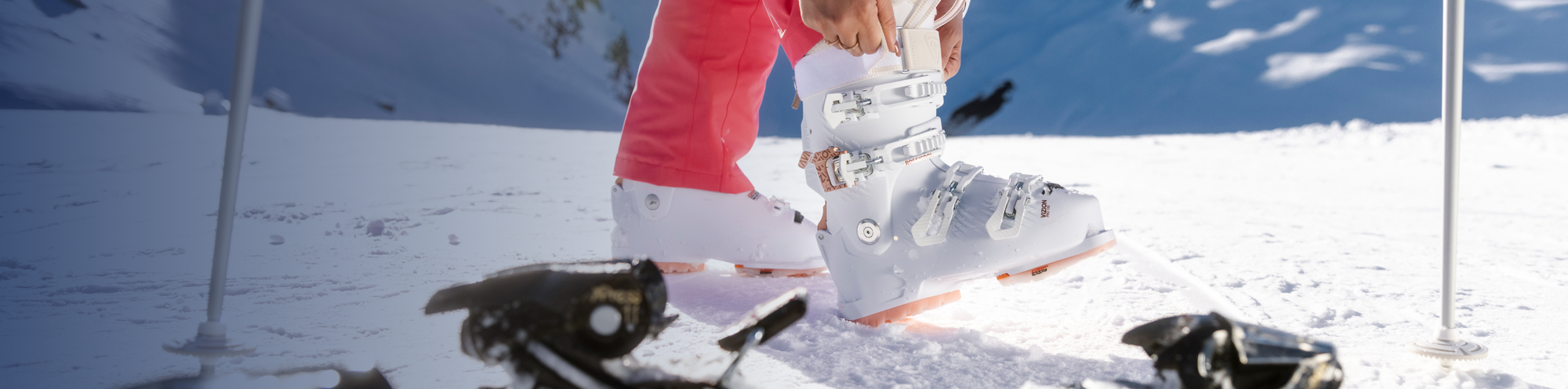
2. HOW TO CHOOSE SKI BOOTS
BASED ON YOUR ALPINE SKIING DISCIPLINE
Choosing the right ski boots is essential to maximizing both performance and comfort on the slopes. The best boot for you depends not just on ability level, but on your skiing discipline. Race, All-Mountain, Freeride, and Touring each require specific boot features—ranging from flex and fit to weight and design. Here’s how to find the right boot for your style of skiing.
RACE SKI BOOTS
Race skiing is all about maximum precision, speed, and control. Race boots are designed for expert skiers who need instant power transfer and stability when carving aggressive turns on hard, icy snow.
-
Flex: Stiff flex is essential, providing superior responsiveness and snap for quick edge-to-edge transitions.
-
Fit: A race boot should fit like a second skin—tight, secure, and uncompromising—for optimal precision. Heat-moldable liners or custom-fit shells are often used to achieve a truly personalized fit.
-
Boot Design: Rigid construction with a high cuff offers the ankle support needed for aggressive skiing at high speeds, keeping every movement precise and controlled.
ALL-MOUNTAIN SKI BOOTS
All-mountain skiing means versatility—moving between groomed slopes, moguls, and occasional powder stashes. All-mountain boots need to balance comfort with performance to adapt to changing terrain.
-
Flex: Medium flex works best, offering a blend of comfort, control, and responsiveness for mixed conditions.
-
Fit: A snug but comfortable fit is key for all-day skiing. These boots should provide enough precision for carving while staying comfortable for long sessions on the hill.
-
Boot Design: Hybrid designs are common, with cuffs and soles that perform well on-piste but can also handle softer snow and variable terrain.
FREERIDE SKI BOOTS
Freeride skiing takes you off the groomed slopes and into variable conditions, from deep powder to steep technical lines. Boots in this category need to combine downhill performance with off-piste adaptability.
-
Flex: Medium to stiff flex strikes the balance between stability at speed and comfort for longer freeride days.
-
Fit: Comfort is especially important here, since freeride skiers often hike or spend long hours in their boots. A slightly roomier fit can reduce pressure points without sacrificing control.
-
Boot Design: Look for boots with features like a walk mode, grippy soles, or tech binding compatibility. These allow for short hikes, bootpacks, or mixed terrain approaches while maintaining downhill performance.
TOURING SKI BOOTS
Touring is all about efficiency on the climb and reliability on the descent. Touring boots are designed to be lightweight and flexible for uphill travel while still offering enough stiffness for control on the way down.
-
Flex: Generally softer than freeride or race boots, though advanced touring boots may include stiffer options for better downhill performance.
-
Fit: Comfort and mobility are critical. Touring boots should allow for a wide range of motion in walk mode while staying supportive enough for descents.
-
Boot Design: Weight-saving designs, walk modes with high cuff rotation, and rockered soles for traction are essential. Many models also feature tech inserts for pin bindings to maximize climbing efficiency.
3. DETERMINE THE FLEX*
OF YOUR SKI BOOTS
Evaluation of your practice, your level of skiing, and your size and weight will determine the right flex for your ski boots.
So, what is flex? Flex is the indicator of the stiffness of your boot. The higher the flex rating, the more rigid and reactive the boot will be, offering maximum precision and power transfer. In contrast, a softer flex is more tolerant, forgiving, and comfortable, making it easier to learn and progress.
It’s important to note that flex is not determined only by level: a lighter skier will often need a softer boot to flex it effectively, while a heavier or stronger skier may require a stiffer flex—even at the same ability level—to get the right support and performance. Choosing the correct flex is crucial for both comfort and control on the slopes.
Warning:
• A flex too rigid for the average skier will be a limiting factor in its progression.
• For a very heavy and powerful skier, it will increase the flex of the boot.
Also, the type of practice is crucial: It does not require a shoe Freestyle the same qualities of strength and flex as a trail shoe, where the power transfer is very important.
4. SELECT THE WIDTH
OF YOUR SKI BOOTS
Choosing the correct ski boot width is just as important as selecting the right size. The last of a ski boot refers to its width at the forefoot, measured in Mondo Point size (the length of your foot in centimeters). Ski boots range from 92 mm to 104 mm in width, and selecting the right width ensures comfort, control, and performance on the slopes.
-
Narrow Feet: For narrow feet, opt for boots with a narrow last (92 mm to 98 mm). These provide a snug, secure fit and are ideal for skiers who prefer more precise control on hard snow or during aggressive skiing.
-
Medium Width Feet: If your feet have a medium width, most ski boots with a medium last (100 mm to 102 mm) will provide a good fit, offering a balance of comfort, support, and performance for versatile skiing across all conditions.
-
Wide Feet: For wider feet, select boots with a wider last (102 mm and above). This ensures the boots don’t squeeze or compress your toes, offering comfort and preventing pressure points, which is especially important for long days on the mountain.
When trying on ski boots, ensure the foot wrap is uniform across the foot, providing solid support at the metatarsal and heel. At the same time, the toes should have some room to move, without being cramped against the boot's tip. A boot that is too narrow will create discomfort, while one that is too wide may result in reduced control.
Additionally, some boots feature heat-moldable liners or custom footbeds, which can improve the fit for those with specific foot shapes. For the best results, consider getting a professional boot fitting to ensure a perfect fit and enhanced skiing experience.
5. HOW TO CHOOSE THE
SIZE OF YOUR SKI BOOTS
Choosing the right size ski boot is essential for comfort, performance, and safety on the slopes. Ski boots are typically measured using the Mondo Point Size (MPS) or the Metric Sizing System (MSS), which corresponds to the length of your foot in centimeters. Getting the correct size ensures that your foot is well-supported and properly aligned in the boot, which is key for effective energy transfer and control.
MEASURING AND SIZING
Ski boots should fit snugly but comfortably. The length of the boot is determined by your foot length, measured in centimeters. When you try on the boot, ensure that the toes are lightly touching the tip of the boot in a flexed position, as your foot will shift back slightly when standing. When skiing, your foot will be under pressure and slightly expand, so the fit should be snug but not painful.
To determine the right size, consider measuring your foot in Mondo Point (MPS), where your boot size corresponds to the length of your foot in centimeters. For example, if your foot measures 26.5 cm, you will likely wear a 26.5 Mondo Point boot.
HOW SKI BOOTS SHOULD FIT: KEY CONSIDERATIONS FOR CHOOSING THE RIGHT FIT
-
Ski Sock Choice: Your ski socks play a significant role in how comfortable your ski boots will be. Ski socks should be thin, moisture-wicking, and designed for skiing to avoid any discomfort caused by bulky socks. Keep in mind that the sock thickness can affect the fit of the boot, so always wear the socks you plan to use when testing boots.
-
Tightening Margin: When testing the ski boot, remember to leave a slight tightening margin. Initially, the boot may feel snug, but when your foot warms up and expands during skiing, it may feel looser. A well-fitting boot should feel snug without causing discomfort or restricting circulation. Pay attention to the boot’s closure system (buckles, straps, and laces) to ensure it holds your foot securely without being too tight.
-
Liner Settling: The liner of a ski boot, which is the soft inner part of the boot that molds around your foot, will settle and conform to the shape of your foot after a few uses on the snow. This means that the boot may feel slightly tighter during the first few outings, but it will adapt over time, offering a custom fit as the liner adjusts. It’s normal for the boot to feel a bit more snug at first but loosens as the liner breaks in.
FOOT AND BOOT SHAPE
While size is important, so is the shape of your foot. Some people have wider feet, while others have narrower feet. Ski boots come in different shapes, or lasts, which refer to the width and overall shape of the boot. Ensure you choose a boot that matches the shape of your foot. If you have wide feet, look for boots with a wider last; if your feet are narrow, a boot with a narrower last will provide a better fit.
CUSTOM FITTING
For the best fit, consider a custom boot fitting. Many ski shops offer custom fittings where a boot technician can heat-mold the liner to your foot shape. This is especially helpful if you have unique foot characteristics or have difficulty finding boots that fit comfortably off the shelf. Custom insoles can also provide additional support and comfort.
ADDITIONAL TIPS
-
Make sure you test both boots before making a decision. Often, one foot is slightly larger than the other, so ensure that both boots feel comfortable.
-
Take your time and don’t rush the fitting process. It’s important to spend time in the boots and walk around a bit before finalizing your decision.
-
Remember that a boot that is too tight can cause discomfort and foot fatigue, while a boot that is too loose can lead to lack of control and reduced performance.
By choosing the right size and fit, you’ll enjoy greater comfort and control, enhancing your skiing experience. A proper fit is key to improving both your safety and performance, so make sure to invest time in selecting the perfect ski boots for your needs.
So take time to choose your shoe, and remember:
• Whether your ski sock is also a major element of the comfort of your foot.
• To maintain a tightening margin during the test of the shoe. Indeed, when the foot is warm and expanded.
• To keep in mind that the liner will settle a bit after a few outings on snow.
HOW TO CHOOSE
YOUR SKI BOOTS
Choosing the right ski boot is essential. It is, in fact, what makes the link between your foot and your ski. The shoe must give you strength and comfort. It will transmit information to the ski, energy, but also insulate your foot, protect it from the cold.
Your skill level
Your discipline
The flex
The width
The size
1. HOW TO CHOOSE SKI BOOTS BASED ON YOUR SKILL LEVEL
When choosing the right ski boots, it’s important to consider your skill level, as the fit and flex of the boot directly impact comfort, control, and performance on the slopes. Ski boots come in different stiffness and features depending on whether you're a beginner, intermediate, or expert skier, and selecting the appropriate pair based on your ability will make a big difference in your overall skiing experience.
BEGINNER SKI BOOTS :
For beginners, comfort and ease of use are essential. Choose softer flex boots, as they are generally more forgiving and easier to control. Softer boots allow for more natural movement and flexibility, helping you learn the basics of skiing without feeling too restricted.
That said, boot flex should also be matched to your anatomy. A skier’s weight and strength play a big role: lighter skiers often need softer flex to bend the boot effectively, while heavier or stronger skiers may require a slightly stiffer flex—even at the beginner level—for proper support and stability.
Beginner boots should still offer a snug, comfortable fit to prevent pressure points and blisters, while allowing smoother turns and greater stability at slower speeds.
INTERMEDIATE SKI BOOTS :
As you progress to an intermediate skier, you’ll want ski boots that provide a balance between comfort and performance. Medium-flex boots offer more support and control while still being flexible enough to maneuver through different types of terrain. They allow for better precision in turns and provide more stability at higher speeds compared to softer boots. Look for boots with a snug fit that offer adequate control but also allow for some movement, providing a good blend of comfort and performance.
EXPERT SKI BOOTS :
For expert skiers, stiff flex boots are essential. These boots provide the highest level of control, responsiveness, and power transmission, especially at high speeds and on challenging terrain. Stiff boots are ideal for those who ski aggressively, require quick edge-to-edge transitions with snap, and demand maximum precision for carving and technical maneuvers.
An expert boot should fit snugly and provide excellent support without any discomfort. Engineered for immediate energy transfer, these boots convert subtle skier inputs into powerful turns with minimal lag, ensuring stability and accuracy on steep slopes, deep powder, and variable snow conditions.
2. HOW TO CHOOSE SKI BOOTS
BASED ON YOUR ALPINE SKIING DISCIPLINE
Choosing the right ski boots is essential to maximizing both performance and comfort on the slopes. The best boot for you depends not just on ability level, but on your skiing discipline. Race, All-Mountain, Freeride, and Touring each require specific boot features—ranging from flex and fit to weight and design. Here’s how to find the right boot for your style of skiing.
RACE SKI BOOTS
Race skiing is all about maximum precision, speed, and control. Race boots are designed for expert skiers who need instant power transfer and stability when carving aggressive turns on hard, icy snow.
-
Flex: Stiff flex is essential, providing superior responsiveness and snap for quick edge-to-edge transitions.
-
Fit: A race boot should fit like a second skin—tight, secure, and uncompromising—for optimal precision. Heat-moldable liners or custom-fit shells are often used to achieve a truly personalized fit.
-
Boot Design: Rigid construction with a high cuff offers the ankle support needed for aggressive skiing at high speeds, keeping every movement precise and controlled.
ALL-MOUNTAIN SKI BOOTS
All-mountain skiing means versatility—moving between groomed slopes, moguls, and occasional powder stashes. All-mountain boots need to balance comfort with performance to adapt to changing terrain.
-
Flex: Medium flex works best, offering a blend of comfort, control, and responsiveness for mixed conditions.
-
Fit: A snug but comfortable fit is key for all-day skiing. These boots should provide enough precision for carving while staying comfortable for long sessions on the hill.
-
Boot Design: Hybrid designs are common, with cuffs and soles that perform well on-piste but can also handle softer snow and variable terrain.
FREERIDE SKI BOOTS
Freeride skiing takes you off the groomed slopes and into variable conditions, from deep powder to steep technical lines. Boots in this category need to combine downhill performance with off-piste adaptability.
-
Flex: Medium to stiff flex strikes the balance between stability at speed and comfort for longer freeride days.
-
Fit: Comfort is especially important here, since freeride skiers often hike or spend long hours in their boots. A slightly roomier fit can reduce pressure points without sacrificing control.
-
Boot Design: Look for boots with features like a walk mode, grippy soles, or tech binding compatibility. These allow for short hikes, bootpacks, or mixed terrain approaches while maintaining downhill performance.
TOURING SKI BOOTS
Touring is all about efficiency on the climb and reliability on the descent. Touring boots are designed to be lightweight and flexible for uphill travel while still offering enough stiffness for control on the way down.
-
Flex: Generally softer than freeride or race boots, though advanced touring boots may include stiffer options for better downhill performance.
-
Fit: Comfort and mobility are critical. Touring boots should allow for a wide range of motion in walk mode while staying supportive enough for descents.
-
Boot Design: Weight-saving designs, walk modes with high cuff rotation, and rockered soles for traction are essential. Many models also feature tech inserts for pin bindings to maximize climbing efficiency.
3. DETERMINE THE FLEX*
OF YOUR SKI BOOTS
Evaluation of your practice, your level of skiing, and your size and weight will determine the right flex for your ski boots.
So, what is flex? Flex is the indicator of the stiffness of your boot. The higher the flex rating, the more rigid and reactive the boot will be, offering maximum precision and power transfer. In contrast, a softer flex is more tolerant, forgiving, and comfortable, making it easier to learn and progress.
It’s important to note that flex is not determined only by level: a lighter skier will often need a softer boot to flex it effectively, while a heavier or stronger skier may require a stiffer flex—even at the same ability level—to get the right support and performance. Choosing the correct flex is crucial for both comfort and control on the slopes.
Warning:
• A flex too rigid for the average skier will be a limiting factor in its progression.
• For a very heavy and powerful skier, it will increase the flex of the boot.
Also, the type of practice is crucial: It does not require a shoe Freestyle the same qualities of strength and flex as a trail shoe, where the power transfer is very important.
4. SELECT THE WIDTH
OF YOUR SKI BOOTS
Choosing the correct ski boot width is just as important as selecting the right size. The last of a ski boot refers to its width at the forefoot, measured in Mondo Point size (the length of your foot in centimeters). Ski boots range from 92 mm to 104 mm in width, and selecting the right width ensures comfort, control, and performance on the slopes.
-
Narrow Feet: For narrow feet, opt for boots with a narrow last (92 mm to 98 mm). These provide a snug, secure fit and are ideal for skiers who prefer more precise control on hard snow or during aggressive skiing.
-
Medium Width Feet: If your feet have a medium width, most ski boots with a medium last (100 mm to 102 mm) will provide a good fit, offering a balance of comfort, support, and performance for versatile skiing across all conditions.
-
Wide Feet: For wider feet, select boots with a wider last (102 mm and above). This ensures the boots don’t squeeze or compress your toes, offering comfort and preventing pressure points, which is especially important for long days on the mountain.
When trying on ski boots, ensure the foot wrap is uniform across the foot, providing solid support at the metatarsal and heel. At the same time, the toes should have some room to move, without being cramped against the boot's tip. A boot that is too narrow will create discomfort, while one that is too wide may result in reduced control.
Additionally, some boots feature heat-moldable liners or custom footbeds, which can improve the fit for those with specific foot shapes. For the best results, consider getting a professional boot fitting to ensure a perfect fit and enhanced skiing experience.
5. HOW TO CHOOSE THE
SIZE OF YOUR SKI BOOTS
Choosing the right size ski boot is essential for comfort, performance, and safety on the slopes. Ski boots are typically measured using the Mondo Point Size (MPS) or the Metric Sizing System (MSS), which corresponds to the length of your foot in centimeters. Getting the correct size ensures that your foot is well-supported and properly aligned in the boot, which is key for effective energy transfer and control.
MEASURING AND SIZING
Ski boots should fit snugly but comfortably. The length of the boot is determined by your foot length, measured in centimeters. When you try on the boot, ensure that the toes are lightly touching the tip of the boot in a flexed position, as your foot will shift back slightly when standing. When skiing, your foot will be under pressure and slightly expand, so the fit should be snug but not painful.
To determine the right size, consider measuring your foot in Mondo Point (MPS), where your boot size corresponds to the length of your foot in centimeters. For example, if your foot measures 26.5 cm, you will likely wear a 26.5 Mondo Point boot.
HOW SKI BOOTS SHOULD FIT: KEY CONSIDERATIONS FOR CHOOSING THE RIGHT FIT
-
Ski Sock Choice: Your ski socks play a significant role in how comfortable your ski boots will be. Ski socks should be thin, moisture-wicking, and designed for skiing to avoid any discomfort caused by bulky socks. Keep in mind that the sock thickness can affect the fit of the boot, so always wear the socks you plan to use when testing boots.
-
Tightening Margin: When testing the ski boot, remember to leave a slight tightening margin. Initially, the boot may feel snug, but when your foot warms up and expands during skiing, it may feel looser. A well-fitting boot should feel snug without causing discomfort or restricting circulation. Pay attention to the boot’s closure system (buckles, straps, and laces) to ensure it holds your foot securely without being too tight.
-
Liner Settling: The liner of a ski boot, which is the soft inner part of the boot that molds around your foot, will settle and conform to the shape of your foot after a few uses on the snow. This means that the boot may feel slightly tighter during the first few outings, but it will adapt over time, offering a custom fit as the liner adjusts. It’s normal for the boot to feel a bit more snug at first but loosens as the liner breaks in.
FOOT AND BOOT SHAPE
While size is important, so is the shape of your foot. Some people have wider feet, while others have narrower feet. Ski boots come in different shapes, or lasts, which refer to the width and overall shape of the boot. Ensure you choose a boot that matches the shape of your foot. If you have wide feet, look for boots with a wider last; if your feet are narrow, a boot with a narrower last will provide a better fit.
CUSTOM FITTING
For the best fit, consider a custom boot fitting. Many ski shops offer custom fittings where a boot technician can heat-mold the liner to your foot shape. This is especially helpful if you have unique foot characteristics or have difficulty finding boots that fit comfortably off the shelf. Custom insoles can also provide additional support and comfort.
ADDITIONAL TIPS
-
Make sure you test both boots before making a decision. Often, one foot is slightly larger than the other, so ensure that both boots feel comfortable.
-
Take your time and don’t rush the fitting process. It’s important to spend time in the boots and walk around a bit before finalizing your decision.
-
Remember that a boot that is too tight can cause discomfort and foot fatigue, while a boot that is too loose can lead to lack of control and reduced performance.
By choosing the right size and fit, you’ll enjoy greater comfort and control, enhancing your skiing experience. A proper fit is key to improving both your safety and performance, so make sure to invest time in selecting the perfect ski boots for your needs.
So take time to choose your shoe, and remember:
• Whether your ski sock is also a major element of the comfort of your foot.
• To maintain a tightening margin during the test of the shoe. Indeed, when the foot is warm and expanded.
• To keep in mind that the liner will settle a bit after a few outings on snow.